
All chimneys, regardless of age, could have defects that are not clearly visible. Maintaining your chimney and keeping it in good condition is critical for safe burning.
At Klinefelter Co Masonry Inc we perform all types of chimney maintenance, chimney restoration, chimney inspection, chimney sweep, chimney tuckpointing, and chimney rebuilding in St. Paul, Twin Cities and nearby areas.
Your chimney may appear to be in fine condition on the outside, but potentially dangerous situations such as cracked or broken clay flue tiles, improper clearances to combustibles, or many other problems could go undetected by the untrained eye. A properly functioning chimney liner is crucial to the safe and efficient use of your fireplace, stove, furnace, or boiler. If your chimney isn’t lined, or if you’re noticing crumbling mortar, loose or chipping brick, or cracks along the side, call our chimney experts in St. Paul today for a quote.
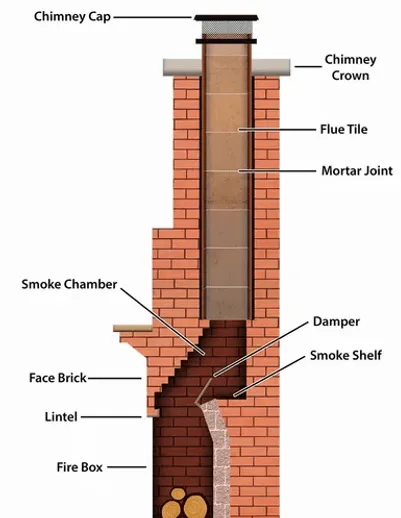
A leaky chimney is a common problem, but it is not a singular issue; it is a clear symptom
of one or more serious underlying structural failures. The purpose of a chimney’s cap,
crown, flashing, and mortar is to act as a series of protective barriers, keeping water from
entering the structure. When an intrusion occurs, it signals failure by one of these barriers.
Water is often referred to as a chimney’s “arch nemesis” because it can cause a variety of
cascading damage. This includes:
Summary of Chimney Problems and Solutions
| Problem | Signs to Look For | Common Fix | When to Rebuild |
|---|---|---|---|
| Water Leak | Water stains on walls or ceiling, water dripping into fireplace, rust on the damper | Chimney cap/crown replacement, flashing repair | When water has caused widespread structural damage |
| Deteriorating Masonry | Spalling (flaking/crumbling) bricks, efflorescence (white stains), cracked mortar joints | Tuck-pointing, brick repair/replacement | When the chimney is leaning, or mortar is crumbling throughout its depth |
| Flue Damage | Smoke entering the home, flakes of clay tile in firebox, unusual odors | Chimney liner replacement | When the flue and chimney structure are compromised and unsafe |
| Obstruction | Smoke backup, animal noises, nesting materials, or debris in firebox | Professional cleaning/removal, chimney cap installation | N/A |
The difference between a chimney repair and a complete rebuild is determined by the
extent of the damage to its structural integrity. Repairs are a targeted solution for localized
problems, such as replacing a few damaged bricks or performing tuck-pointing to address
crumbling mortar joints. In contrast, a complete rebuild is a comprehensive solution that
becomes necessary when damage is widespread and severe. Signs that a rebuild is
needed would be:
A chimney liner is a protective barrier that fits inside the chimney, directing smoke and
fumes safely out of the home. Besides improving efficiency, its purpose is to ensure safety.
Cracked, compromised, or missing liner can lead to two life-threatening hazards:
Tuck-pointing is a crucial repair process where old, cracked, or crumbling mortar joints
between bricks are carefully removed and replaced with fresh, new mortar. Having a
shorter lifespan than the surrounding brickwork leads to erosion over time due to everyday
weathering. Tuck-pointing is not only a cosmetic repair; its role is to restore the chimney’s
structural integrity and prevent water from seeping into the masonry. By addressing failing
mortar joints early with tuck-pointing, a homeowner can avoid a costly tear-down or rebuild
in the future.